

Turkish Citizenship Property Eligibility: What to Check Before Paying a Deposit
A property advertised as “suitable for Turkish citizenship” still needs to be checked against your proposed purchase. Before paying a deposit, establish what you are buying, who can sell it, how the investment amount will be confirmed and what happens if the transaction cannot proceed.
This guide focuses on that decision point. It explains which official requirements matter and gives you a practical way to organise the evidence before committing money.
Research date: 23 September 2026. Official guidance is linked below. The buyer checklists and examples are practical recommendations, not an exhaustive statement of Turkish law or a substitute for a property-specific legal opinion.
What makes a property eligible for Turkish citizenship?
Türkiye’s Investment Office states that the real-estate route requires a minimum investment of USD 400,000 or the permitted foreign-currency equivalent, with a registered restriction against resale for at least three years. The investment must be confirmed through the relevant official process; citizenship remains subject to the government’s decision. [1]
Treat an eligibility claim as the start of a document review. Ask the person making the claim to identify the exact unit and explain the evidence supporting it. A development name and a price list are insufficient for making a deposit decision.
For the wider programme, read our Turkish citizenship through real-estate guide. For this article, the central question is narrower: what must be resolved before your money becomes contractually committed?
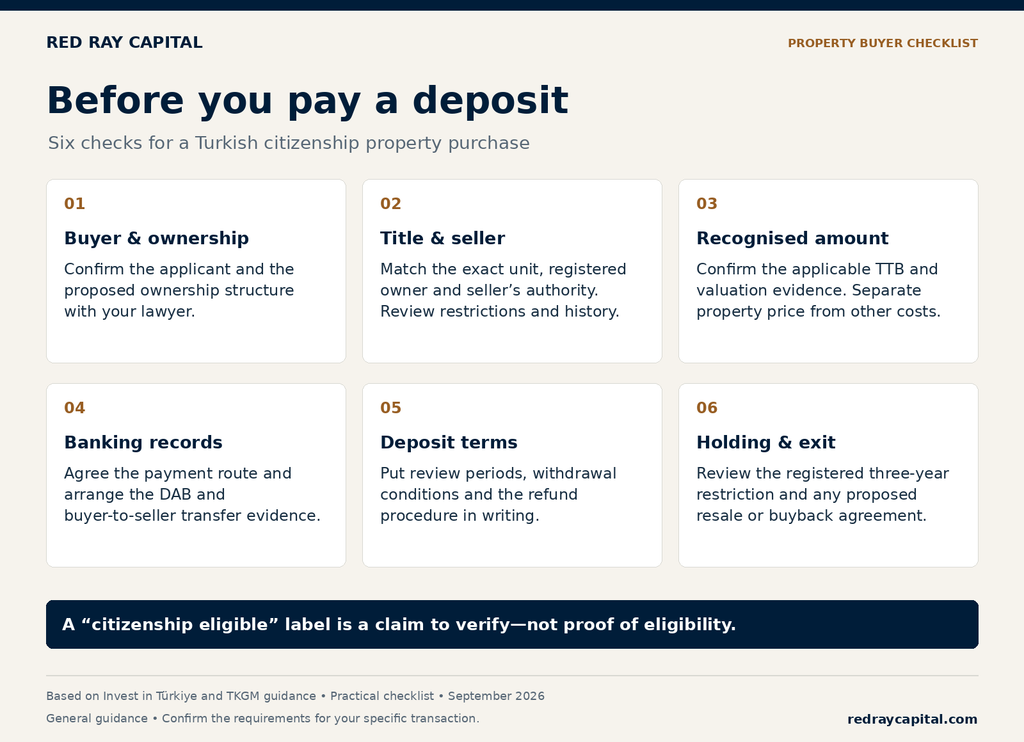
Contents
- Check the buyer and proposed ownership
- Identify the property and inspect the title
- Review the seller and ownership history
- Confirm the investment amount and TTB documentation
- Plan the banking and payment evidence
- Protect the deposit through written terms
- Use the pre-deposit checklist
- Frequently asked questions
1. Check the buyer and proposed ownership first
Official guidance confirms that nationality and location restrictions apply to foreign property purchases, including military or security zones and acquisition limits. Permission to buy should therefore be checked for the actual applicant and property. [1]
Give your appointed Turkish lawyer a short written brief: your nationality, current country of residence, proposed purchaser, intended use and whether citizenship is the purpose of the transaction. Explain immediately if you plan to buy jointly, through a company or using money held by another person.
Ask for the conclusion in writing: is the proposed ownership structure appropriate for this application, and which questions remain unresolved? Do not change the named purchaser between reservation, banking and completion without a fresh review.
2. Identify the exact property and inspect the title
The Investment Office explains that ownership depends on Land Registry registration. A preliminary contract does not itself transfer ownership. Its guidance also calls for checking mortgages, liens and other restrictions before the transaction. [1]
Request a recent title record rather than relying only on an old photograph of a Tapu. Have your lawyer reconcile the province, district, parcel, block and independent-unit details against the reservation form and the apartment you viewed.
Make discrepancies visible. If the brochure uses one apartment number and the registry another, obtain a written explanation before signing. If a parking space or storage room is included in the price, ask how that right is documented. If there is an existing mortgage, request a specific discharge plan showing who pays, when it is released and how completion is protected.
Inspect legal status and physical condition separately
Ask a suitable professional to review the building’s planning, construction and occupation documentation, as relevant to the unit. Ask a technical inspector to assess the property’s condition and any issues requiring specialist investigation. An attractive show apartment does not answer questions about the purchased unit’s records or construction.
For an unfinished property, request a dated construction schedule, the agreed delivery specification and the contractual remedy for delay. Keep these records with the purchase file so that future discussions refer to the same agreed standard.
3. Review the seller and ownership history
TKGM’s published citizenship guidance contains conditions concerning transaction parties and prior ownership, including restrictions involving foreign owners and certain family relationships. These are reasons to examine the specific transaction, not to accept eligibility based solely on a seller’s nationality. [2]
Ask your lawyer to record who owns the unit, who will sign, who will receive payment and whether the property’s ownership history creates a citizenship issue. For a corporate seller, request evidence of the company’s identity and the signatory’s authority.
Your written questions should include whether the unit has previously supported a citizenship application and whether any relationship between buyer, seller or previous owners affects the proposed purchase. Ask which records were inspected to reach the conclusion.
If someone proposes a guaranteed buyback, provide the whole arrangement to your lawyer before accepting it. A promised exit should be reviewed together with the original purchase, including the proposed future buyer and all side agreements.
4. Confirm the recognised investment amount—not just the advertised price
TKGM’s documentation includes the Taşınmaz Edinim Sureti ile Vatandaşlık Kazanımına Esas Tutar Tespit Belgesi, abbreviated TTB: a document determining the amount relevant to citizenship through property acquisition. Its December 2024 announcement refers to confirmation of citizenship-related transactions through this document. Ask your lawyer to confirm the applicable TTB and valuation procedure for your purchase. [3] [4]
Do not treat a seller’s appraisal, a market-price estimate and the required official confirmation as interchangeable. Ask who obtains each document, which property it identifies, when it was issued and whether it will remain acceptable at the intended transaction date.
TKGM’s published FAQ states that TTBs issued after 9 December 2024 have a six-month validity period. Have the adviser confirm the relevant document’s validity and any transaction-specific exceptions before relying on it. [5]
Separate property value from package costs
TKGM’s guidance excludes items such as VAT, commissions, expenses, taxes and fees from the property-price component of the foreign-exchange amount used for the declaration. [2]
For example, imagine a proposed USD 420,000 package described as USD 390,000 for the apartment and USD 30,000 for services and charges. The headline package figure does not establish a USD 400,000 property investment. This is an illustrative calculation, not a valuation of any development.
Request an itemised quotation and ask the adviser to mark which amounts belong to the property transaction and which are separate costs. Compare the unit with similar properties on a consistent basis: size, condition, location, floor and included rights. Paying more should not be used as a substitute for checking value.
Our complete investment-cost guide discusses the wider budget. Keep that budget separate from the evidence used to establish the qualifying investment.
5. Plan the banking evidence before transferring funds
TKGM’s foreign-exchange notice explains that relevant foreign-buyer purchases require currency conversion through a bank and a Döviz Alım Belgesi (DAB), or foreign-exchange purchase document. For property-based citizenship, proof of the buyer-to-seller bank transfer is also required. The DAB and the payment receipt serve different purposes. [6]
Before sending a reservation payment or instalment, ask the bank and lawyer to agree the payment sequence. Record the recipient, currency, amount, reference wording and documents expected afterwards. If funds originate from a joint account, a business or a relative, explain that arrangement before the transfer.
Prepare a reconciliation sheet with one row for each payment. Include the transfer date, sender, recipient, transaction reference, amount, currency and related property. Keep bank charges separate and identify any difference between the amount instructed and the amount received.
If an agent sends new bank details, verify the change through an independently established contact channel. Do not rely on the fact that the email looks familiar. Ask who is contractually entitled to receive the funds and why.
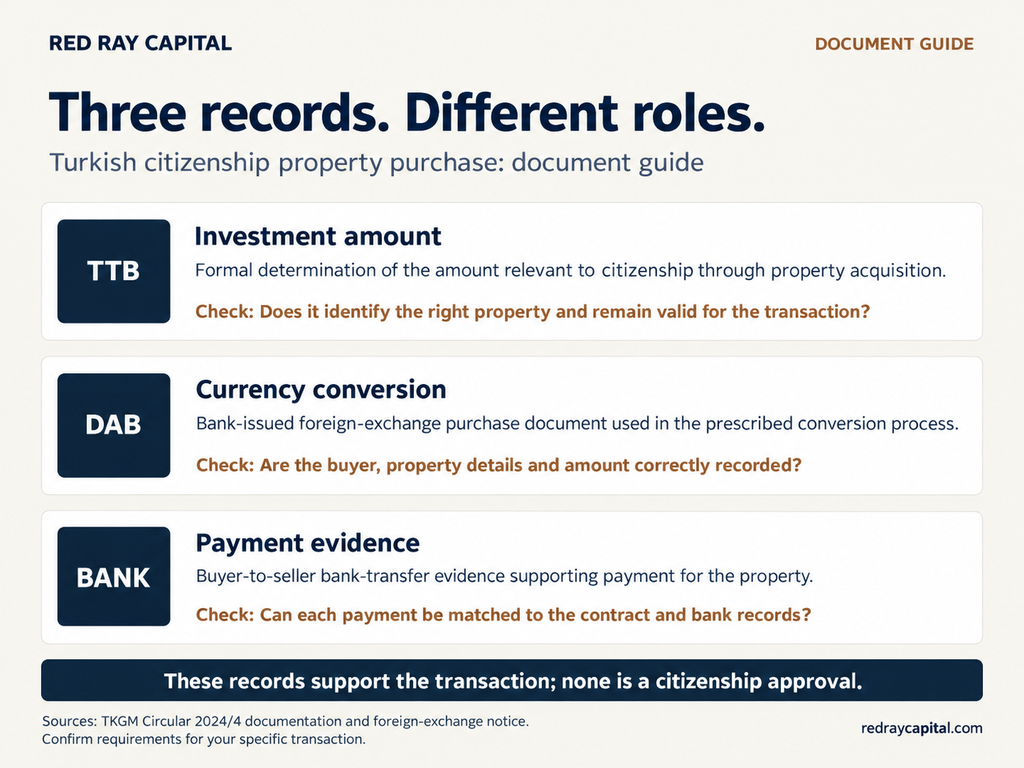
6. Put the deposit conditions in writing
A reservation payment creates a practical risk: you may discover a problem after the seller has received your money. Before paying, ask your lawyer to negotiate terms that match the investigations still outstanding. The following are proposed discussion points, not rights that every buyer automatically has:
- Exact unit: identify the property and prevent an unapproved substitution.
- Review period: allow an agreed period for obtaining and examining the necessary evidence.
- Eligibility condition: specify what happens if the proposed property transaction cannot satisfy the citizenship investment requirements.
- Value shortfall: address an official determination that does not support the required amount.
- Title problem: define the seller’s obligation to resolve an unacceptable restriction.
- Refund procedure: state the trigger, evidence, deadline, currency, permitted deductions and party responsible for repayment.
- Failure to complete: explain each party’s position if banking, documents or seller obligations prevent completion.
Compare two hypothetical offers. One asks for an immediate non-refundable deposit while checks are pending. The other allows a defined review period with an agreed refund mechanism for specified failures. Even at the same property price, the buyer’s exposure differs. Read the conditions before judging the offer.
Keep property-related failure separate from an unsuccessful citizenship application arising from the applicant’s circumstances. Ask the lawyer to explain which risks the contract addresses and which remain with you. A broad sentence saying “citizenship guaranteed” is not a useful substitute for precise contractual obligations.
7. Review the holding restriction and proposed exit
Before completion, ask for the proposed restriction wording and an explanation of how its dates will be recorded. Keep the final registry evidence with your purchase documents. Plan a future sale only after your lawyer confirms the applicable restriction has ended and any release procedure is complete.
The published December 2024 TKGM guide contains additional commitments concerning a promise to sell during the commitment period and a later transfer back to the previous owner or that owner’s first-degree relatives. A buyback proposal therefore needs specific legal review even where it is advertised for the end of the holding period. [7]
Assess the exit without assuming a guaranteed buyer. Ask what competing units may be available, what expenses you will incur while holding the property and whether you could retain it longer if a suitable offer does not arrive.
Pre-deposit checklist: what should be in your file?
Use this as a working evidence list. Some formal documents arise later in the transaction; where a document is not yet available, record who will obtain it, by when, and how your contract protects the payment in the meantime.
| Check | Evidence or written answer to request |
|---|---|
| Applicant and ownership | Review of the named purchaser and proposed structure. |
| Property identity | Matching registry, contract and unit details. |
| Seller authority | Owner identification and authority of the signatory. |
| Title and history | Review of restrictions, prior ownership and prior citizenship use. |
| Building records | Relevant approvals, condition review and unresolved issues. |
| Recognised amount | Applicable TTB/valuation procedure, evidence and validity dates. |
| Price breakdown | Property consideration separated from additional charges. |
| Payment route | Banking instructions and plan for DAB and transfer records. |
| Deposit protection | Signed review, withdrawal and refund terms. |
| Completion and exit | Restriction plan and review of any resale or buyback agreement. |
Ask the reviewer to mark each item as confirmed, unresolved or unacceptable. A missing document should remain visible as an outstanding item, rather than disappearing into a general statement that the transaction is “in progress”.
Frequently asked questions
Does a USD 400,000 asking price prove eligibility?
No. Ask for the transaction-specific evidence supporting the investment amount and the other relevant checks described above. The asking price is a commercial proposal.
Should I pay a deposit before all formal documents exist?
That depends on the transaction and your willingness to accept risk. Where evidence is outstanding, have your lawyer explain the exposure and negotiate appropriate conditions before payment. Do not assume a refund will follow automatically.
Can I use two properties or buy jointly with another investor?
Do not assume these structures are equivalent. Ask for a written review of the specific titles, purchasers, payment arrangements and applicable rules before reserving either unit. A shared purchase or multi-property proposal needs its own assessment.
What if the seller offers an instalment plan?
Request a review of when the required payment evidence and official confirmation can be obtained. A commercially attractive instalment schedule should not be treated as confirmation that the citizenship file can proceed immediately.
Does the deposit start the citizenship processing period?
A reservation date is not an application decision date. For the stages after investment preparation, read our Turkish citizenship process and timeline guide.
Discuss the property before committing funds
Red Ray Capital helps clients explore Turkish property opportunities and coordinate the purchase and application journey with appointed professional advisers. Share your preferred property, intended budget and purchase timeframe so that the next steps can be organised around the actual transaction.
Request a property consultation or contact us on WhatsApp: +971 50 719 4407.
Official references
- Investment Office of the Presidency of the Republic of Türkiye — Acquiring Property and Citizenship. Investment threshold, holding restriction, registration and foreign ownership framework.
- TKGM — Citizenship implementation guide dated 1 February 2024 (Turkish). Transaction-party and payment provisions; read with subsequent amendments.
- TKGM Foreign Affairs Department — Official documents (Turkish). Directory listing Circular 2024/4, its guide and the TTB document.
- TKGM — Announcement concerning Circular 2024/4 and the TTB, 11 December 2024 (Turkish).
- TKGM — FAQ on valuation report and TTB validity (Turkish).
- TKGM — Foreign-exchange purchase document notice, 26 January 2022 (Turkish). DAB and citizenship-related bank-transfer evidence.
- TKGM — Amended citizenship implementation guide, December 2024 (Turkish). Commitment wording and specified subsequent transactions.
Source note: Some older TKGM document and FAQ addresses may redirect or display incompletely. Its current Foreign Affairs document directory is also linked above. The Turkish texts and applicable amendments govern; English explanations here are summaries.
This article provides general information. Obtain current advice from an appropriately qualified Turkish lawyer before signing or transferring funds. Administrative requirements can change, individual circumstances matter, and citizenship approval cannot be guaranteed.