

Turkish Citizenship by Investment Process and Timeline: What to Expect in 2026
Most enquiries about Turkish citizenship begin with the investment: which property, which bank or how much? The safer place to begin is the applicant. Before money moves, the family structure, source of funds and proposed investment route should be checked together.
Buying a qualifying asset or placing a qualifying deposit is only part of the process. The investment must be formally confirmed, the investor residence-permit stage must be completed, and the citizenship file must pass government review. Names, dates, payments and family records need to be consistent from beginning to end. No adviser can guarantee the decision or the date on which it will be made.
For an overview of the programme before examining the procedure, read our practical guide to Turkish citizenship by investment.
Prepared by the Red Ray Capital advisory team. Programme details and official links were reviewed on 19 August 2026. Legal, tax and regulated financial advice should be obtained from appropriately qualified professionals.
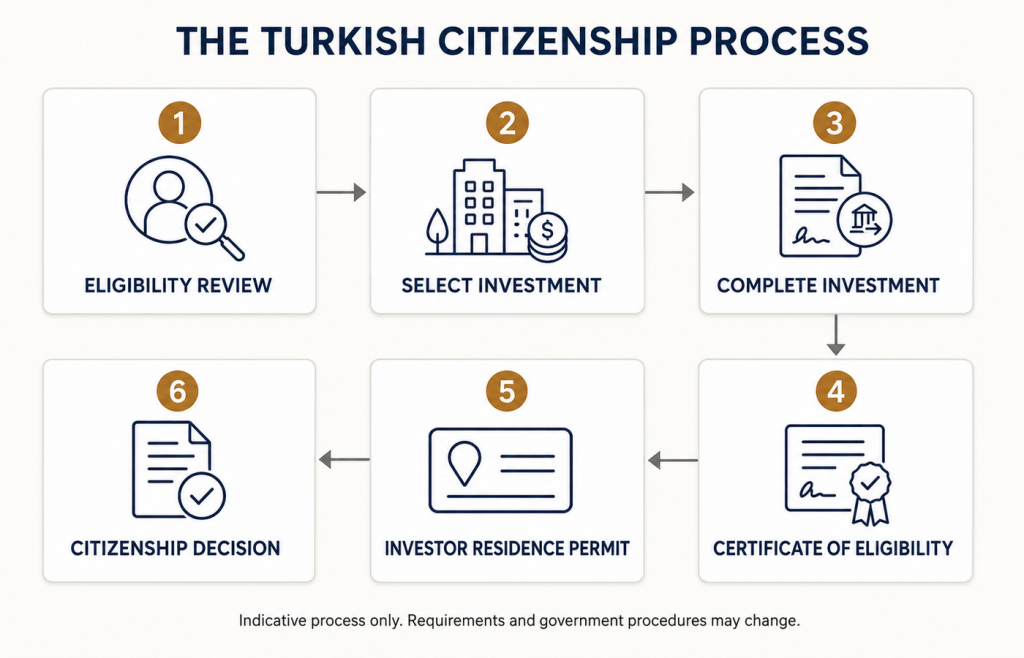
The process at a glance
- Complete a preliminary eligibility, family and risk review.
- Select one recognised investment route and establish the complete budget.
- Prepare identity, civil-status and source-of-funds evidence.
- Complete the investment in the form required by the relevant authority.
- Obtain the route-specific Certificate of Eligibility.
- Complete the investor residence-permit stage.
- Submit the citizenship application for the investor and eligible family members.
- Undergo archive, public-order, national-security and other government checks.
- Following approval and registration, apply for Turkish identity cards and passports.
For planning purposes: allow roughly four to eight months or longer from the first document review to citizenship registration. This is an advisory planning range, not an official service standard. A file involving several jurisdictions, complex banking or additional government checks can take considerably longer.
Contents
- Recognised investment routes
- Turkish citizenship process step by step
- Realistic application timeline
- Document checklist
- Including family members
- Common causes of delay
- Can the process be completed remotely?
- Handling personal and financial documents safely
- What happens after approval?
- Frequently asked questions
Recognised Turkish citizenship investment routes in 2026
There are currently seven recognised ways to qualify. The chosen route determines the minimum commitment, the restriction that must be registered and the authority that will confirm the investment. The published minimum is not the complete budget; banking, tax, transaction and professional costs sit outside it.
| Investment route | Current qualifying condition | Primary holding condition or test |
|---|---|---|
| Real estate | At least USD 400,000 or permitted equivalent | Title-deed restriction preventing sale for at least three years |
| Bank deposit | At least USD 500,000 or permitted equivalent | Funds restricted from withdrawal for at least three years |
| Fixed-capital investment | At least USD 500,000 or permitted equivalent | Investment must be attested by the responsible ministry |
| Government bonds | At least USD 500,000 or permitted equivalent | Qualifying bonds cannot be sold for at least three years |
| Real-estate or venture-capital investment funds | At least USD 500,000 or permitted equivalent | Qualifying fund shares cannot be sold for at least three years |
| Private pension system | At least USD 500,000 or permitted equivalent | Contribution remains in eligible funds for at least three years |
| Job creation | Employment for at least 50 people | Employment must be genuine and attested by the responsible authority |
The thresholds and responsible authorities should be reconfirmed immediately before funds are committed. The Investment Office of the Presidency of the Republic of Türkiye publishes the recognised criteria and the corresponding residence-permit framework.
Real estate is the best-known route, but a property advertised as “citizenship eligible” does not become compliant merely because a developer or broker says so. Investors should review our detailed guide to Turkish citizenship through real-estate investment before paying a reservation fee. Investors considering a financial rather than physical asset can compare the Turkish bank-deposit citizenship route.
Turkish citizenship by investment process: step by step
Step 1: Check the applicant before the investment
This review belongs at the beginning—not after a reservation payment has been made. It should cover the applicant’s nationality, residence history, family structure, source of wealth, source of funds and intended investment route.
At this point, the adviser should look for issues that could change the route, the documents or the risk assessment:
- Citizenship and country-of-residence restrictions affecting banking or property ownership
- Past visa refusals, immigration breaches or deportations
- Criminal allegations, convictions or pending proceedings
- Sanctions, politically exposed person status or adverse media
- Multiple names, transliterations or inconsistent dates across documents
- Previous marriages, divorce, adoption, custody or parental-consent issues
- Whether each proposed family member meets the relevant definition
- Whether the investment capital can be documented from its original source to its transfer into Türkiye
Many avoidable problems begin here: money is sent from the wrong account, a child’s records use a different spelling, or a property is reserved before its eligibility is checked. Finding the issue early does not predict the government’s decision, but it gives the applicant a chance to deal with it lawfully before capital is committed.
Step 2: Select the investment route and establish the complete budget
The route with the lowest published threshold can still be the wrong commercial choice. The decision should reflect the applicant’s liquidity, tolerance for risk, preferred level of management, currency exposure and intended exit after the holding period.
A property investor must evaluate both citizenship compliance and the commercial quality of the asset. A bank-deposit investor must assess bank onboarding, deposit currency, interest, withholding tax, inflation and currency risk. Investors using businesses, bonds, funds or pensions require route-specific legal, tax and financial advice.
Do not budget only for the statutory minimum. Our analysis of the complete Turkish citizenship investment cost beyond USD 400,000 explains why title-deed expenses, valuation, insurance, translations, notarisation, professional review and post-purchase costs must be planned separately.
Step 3: Prepare civil documents and the financial evidence trail
Document preparation can usually run alongside investment due diligence. That does not mean ordering every certificate immediately. First confirm the required issue date and legalisation route; otherwise, an applicant may pay for a document that has to be obtained again.
The financial file needs to answer two different questions. Source of wealth explains how the applicant built their overall financial position. Source of funds traces the particular money being invested—from its origin, through the applicant’s accounts, to the qualifying transaction.
Depending on the applicant’s circumstances, supporting evidence may include employment records, tax returns, audited company accounts, dividend vouchers, shareholding records, property-sale agreements, inheritance documents, documented gifts and bank statements. Large unexplained deposits, circular transfers or payments by unrelated third parties can cause serious questions.
Step 4: Complete due diligence and execute the investment
This is where an otherwise sensible investment can fail as a citizenship investment. Commercial quality and programme compliance are separate tests; the transaction has to satisfy both.
For the property route
The buyer should independently check the registered owner, title history, mortgages, liens, court restrictions, planning and construction status, occupancy documentation, prior citizenship use, seller eligibility, valuation, payment route and proposed title-deed wording.
The official property guidance states that qualifying real estate must meet the current minimum value and carry a declaration that it will not be sold for three years. Land-registry requirements can include identity documents, representation documents where applicable, municipal value records and mandatory earthquake insurance for buildings. See the official guidance on acquiring property and citizenship in Türkiye.
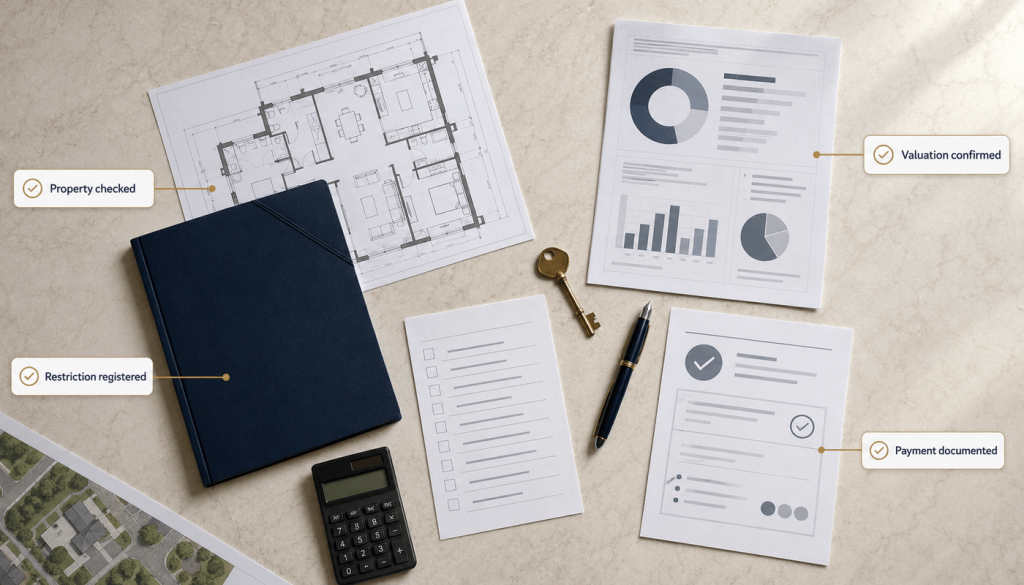
The marketing price, valuation, title-deed declaration and traceable bank payments must be reviewed as one file. The buyer should not complete first and ask about citizenship eligibility afterwards.
For bank deposits and other financial routes
The investor must open the appropriate account or custody arrangement, transfer the qualifying funds through acceptable banking channels and register the prescribed restriction. Fees or deductions must not reduce the recognised amount below the applicable threshold.
The applicant should understand that citizenship eligibility and investment suitability are different assessments. A deposit, bond or fund can satisfy an immigration threshold without necessarily being suitable for the investor’s return objectives or currency position.
Step 5: Obtain the Certificate of Eligibility
After the investment is properly completed, the responsible authority must attest that it satisfies the relevant citizenship condition. This results in the Certificate of Eligibility or equivalent official confirmation.
The competent authority depends on the route. Property files move through the land-registry and responsible ministry channels; bank deposits are attested through the banking regulator; capital investments, government bonds, qualifying funds, pensions and job creation each involve their designated authority.
In practical terms, the payment receipt or title deed is not the final word. The authority responsible for the selected route must verify that the investment meets the programme condition.
Step 6: Complete the investor residence-permit stage
The principal investor must complete the prescribed short-term residence-permit stage under the investor framework before the citizenship process is finalised. This is procedural; it does not generally mean the investor must first live in Türkiye for several years.
Residence-permit documentation may include the application form, passport copy, biometric photographs, fee receipts and route-specific evidence. Requirements should be confirmed for the applicant’s circumstances and place of application. A residence permit is not citizenship, and approval of one stage does not compel approval of the next.
Step 7: Assemble and submit the citizenship application
The citizenship file brings together the investment confirmation, residence-permit record and personal documents for the principal applicant and eligible family members. The responsible Population and Citizenship Directorate reviews the file and forwards it through the official assessment process.
Before filing, read the papers as an examiner would. The following details should match across the entire file:
- Names and transliterations
- Dates and places of birth
- Marriage, divorce, custody and dependency records
- Passport and residence information
- Investment figures and currency conversions
- Bank transfer references
- Contracts, valuation and title-deed details
- Source-of-funds explanations
- Powers of attorney and authorised signatures
A mismatch that appears minor to the applicant may require clarification or a corrected document. It is usually faster to resolve inconsistencies before filing than during government review.
Step 8: Archive, public-order and national-security checks
Government authorities conduct background, archive, public-order and national-security checks. They may request additional information or documents. The depth and duration of review vary between applicants; advisers do not control this stage.
Meeting an investment threshold creates a basis to apply. It does not create an unconditional right to citizenship. Material misrepresentation, undisclosed background issues, false documents or an investment that does not remain compliant can lead to delay, refusal or later review.
Step 9: Decision, registration, identity card and passport
If the application is approved through the competent decision-making process, citizenship is entered into the civil registry. The new citizen can then proceed with applications for a Turkish identity card and passport.
Approval does not end the investor’s responsibilities. A qualifying property, deposit, bond, fund or pension arrangement must remain subject to the prescribed holding condition. Investors should keep the restriction and compliance documents safely and obtain advice before selling, withdrawing or restructuring the investment.
How long does Turkish citizenship by investment take?
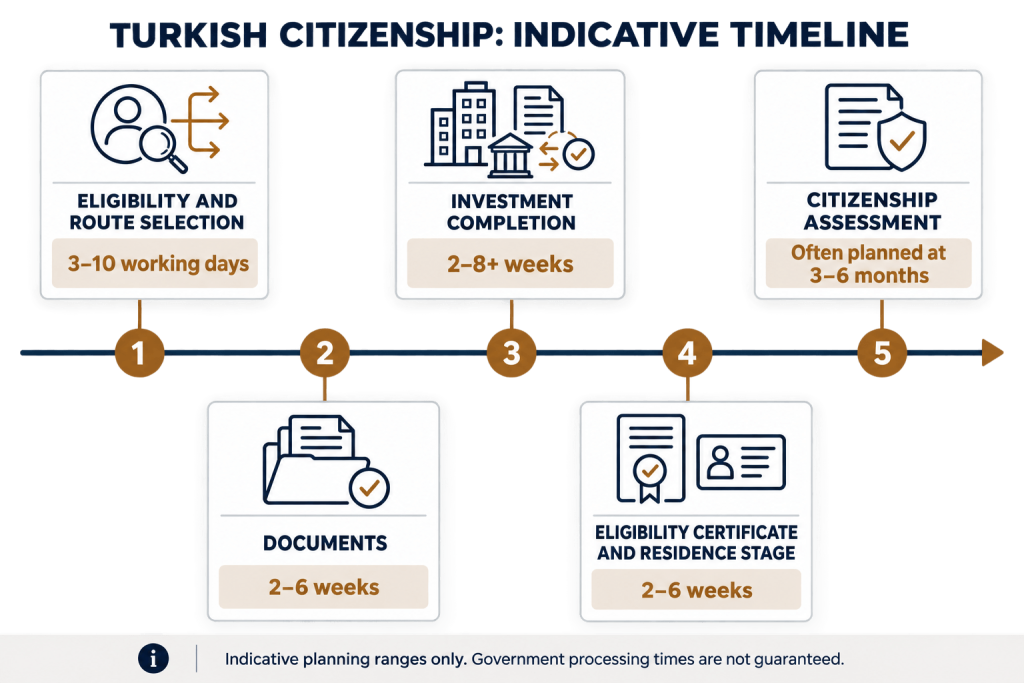
There is no official guaranteed processing time, and two applications submitted in the same week may not finish together. An applicant whose civil records and bank trail are ready is not directly comparable with a family collecting documents from three countries. For planning, separate the work completed before filing from the government assessment that follows.
| Stage | Indicative planning range | What can affect it? |
|---|---|---|
| Initial eligibility and route selection | Approximately 3–10 working days | Family complexity, background issues and availability of financial records |
| Civil and financial document preparation | Approximately 2–6 weeks, often running in parallel | Government issue times, apostille, consular legalisation and translation |
| Investment due diligence and completion | Approximately 2–8 weeks or longer | Property checks, valuation, banking onboarding, fund transfers and contract negotiation |
| Certificate of Eligibility and investor residence stage | Approximately 2–6 weeks | Route, location, appointment availability and requests for corrections |
| Citizenship assessment after complete filing | Often planned at approximately 3–6 months | Security checks, government workload and additional-document requests |
| Identity card and passport after registration | Varies by appointment and delivery arrangements | Application location, biometrics and delivery method |
A straightforward, well-documented case can reasonably be planned at roughly four to eight months from initial preparation to citizenship registration. It may finish sooner; it may also take considerably longer. The ranges above are Red Ray Capital planning estimates—not statutory deadlines, published government service standards or guarantees.
Turkish citizenship document checklist
No universal checklist fits every applicant. Nationality, residence, marital history, children, investment route and source of funds can change the requirements. Commonly requested documents may include:
Personal and family records
- Valid passports
- Birth certificates
- Marriage certificate
- Divorce or former-spouse death records, where applicable
- Children’s birth certificates
- Custody and parental-consent documents, where required
- Proof of residential address
- Biometric photographs
- Police-clearance or other background records, if requested
Investment and application records
- Certificate of Eligibility
- Investor residence-permit records
- Investment contracts and certificates
- Title deed and valuation evidence for property cases
- Bank transfer receipts and account records
- Source-of-funds and source-of-wealth evidence
- Power of attorney, where used
- Certified translations and notarised copies
- Completed application forms and declarations
Documents issued outside Türkiye may need an apostille or consular legalisation, followed by certified Turkish translation and notarisation. The correct form depends on the issuing country and the purpose for which the document will be used.
Can family members be included?
The official framework refers to the principal investor’s spouse and the investor’s or spouse’s minor or dependent children applying together with the investor. A separate qualifying investment is not normally required for each family member included in the same application.
Dependency should not be assumed simply because a relative receives financial support. An adult child’s position and the evidence required should be checked against current administrative practice before the family relies on inclusion. Parents, siblings and other extended relatives are not ordinarily added to the principal applicant’s file. Divorce, shared custody, adoption and children from earlier relationships should be reviewed before documents are legalised.
What commonly delays a Turkish citizenship application?
- Buying before confirming eligibility: the property, seller, valuation or payment arrangement may not meet the programme rules.
- Incomplete source-of-funds evidence: the investment money cannot be traced clearly from origin to final payment.
- Name or date inconsistencies: passports, birth records and translations show different spellings or personal details.
- Incorrect legalisation: a certificate is not apostilled, consularised, translated or notarised in the required form.
- Family-document gaps: missing marriage, divorce, custody or consent records affect one or more applicants.
- Banking delays: account opening, compliance checks or international transfers take longer than expected.
- Third-party payments: funds arrive from a person or entity not properly connected to the applicant or transaction.
- Government requests: the authorities require clarification or conduct additional background review.
- Breaking the holding condition: the investment is sold, withdrawn or restructured too early.
How to reduce avoidable delay
- Complete eligibility and source-of-funds reviews before transferring capital.
- Use independent property, legal, tax and financial professionals where appropriate.
- Obtain a written, route-specific document checklist.
- Prepare a master spelling schedule for every family member.
- Reconcile the contract price, valuation, bank payment and official declarations.
- Keep evidence of every payment and material instruction.
- Do not make changes to the qualifying investment without prior advice.
- Respond to lawful government requests completely and promptly.
Can the Turkish citizenship process be completed remotely?
Many procedural steps can be coordinated through an appropriately drafted power of attorney. This may include document preparation, certain property procedures and communication with appointed professionals or authorities.
However, remote completion should never be promised without checking the applicant’s route, bank, nationality, biometrics and current administrative requirements. A bank or authority may require personal attendance. A power of attorney issued outside Türkiye must also satisfy the applicable form, apostille or consular-legalisation and translation rules.
How to handle personal and financial documents safely
A citizenship file contains high-risk personal information: passports, signatures, home addresses, civil records, bank statements and sometimes information about children. Convenience should not take priority over document security.
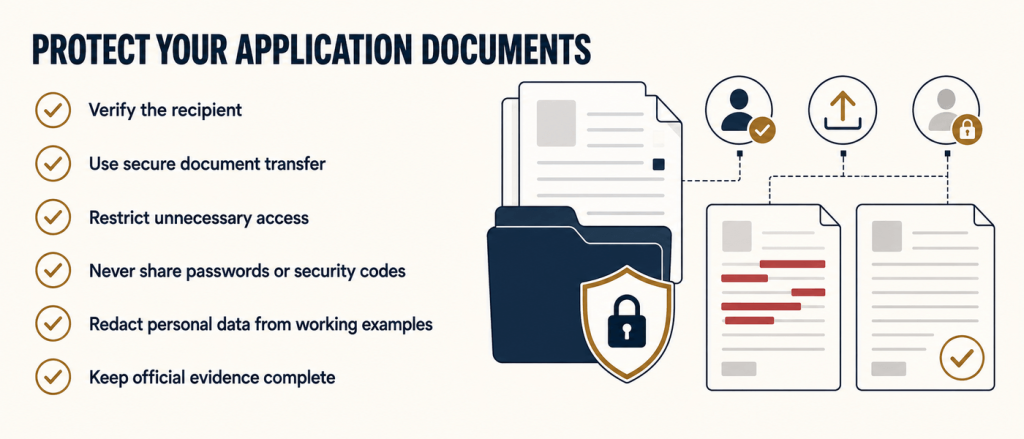
A sensible document-handling protocol should include the following:
- Use a controlled, access-restricted upload channel where one is available.
- Verify the recipient and the reason for the request before sending a document.
- Avoid sending a complete family or banking file through open email chains or messaging groups.
- Never disclose passwords, card PINs or one-time security codes to an adviser.
- Share only the pages and fields reasonably required for the stated purpose.
- Redact unrelated personal numbers from working examples or marketing drafts, but never alter an official document being submitted as evidence.
- Limit access to the appointed advisers, banks, translators and authorities who genuinely need the material.
- Agree how long working copies will be kept and how they will be securely deleted when no longer required.
Data minimisation does not mean withholding a material fact. Redaction must never be used to conceal information required by a bank, regulator or government authority. The correct balance is to provide complete evidence through an appropriate channel while avoiding unnecessary duplication and circulation.
What happens after citizenship approval?
- Confirm that citizenship has been entered in the civil registry.
- Apply for the Turkish identity card and passport.
- Maintain the qualifying investment for the full mandatory period.
- Keep the title-deed annotation, bank restriction or investment confirmation on file.
- Review Turkish and home-country tax, reporting and succession consequences.
- Before the restriction ends, plan the eventual sale, withdrawal or reinvestment.
- Obtain formal confirmation before changing the qualifying asset.
Citizenship and tax residence are separate concepts. Becoming a citizen does not by itself determine the applicant’s complete tax position. Personal advice should consider physical presence, permanent home, income, business activity, family connections and the laws of every relevant jurisdiction.
Frequently asked questions
How quickly can I obtain Turkish citizenship by investment?
There is no guaranteed timeline. A well-prepared case may often be planned at approximately four to eight months from initial preparation to registration, but documentation, investment execution and government screening can make the process shorter or substantially longer.
Do I need to live in Türkiye before applying?
A lengthy period of prior residence is not generally required under the investment route. The prescribed investor residence-permit stage must still be completed.
Do I need to speak Turkish?
There is currently no standard Turkish-language examination for applicants using the recognised investment route. Certified interpreters and translations may still be required for transactions and documents.
Can my spouse and children apply with me?
The official framework refers to the spouse and the investor’s or spouse’s minor or dependent children. The facts and current evidence requirements should be checked for every proposed family member, especially an adult child.
Can I use more than one property to reach USD 400,000?
More than one eligible property may sometimes be used, provided the transactions collectively meet the applicable valuation, seller, payment, registration and timing requirements. The proposed structure should be approved before completion.
Can I rent the qualifying property?
A qualifying property may generally be rented during the holding period if the lease and use do not conflict with the registered restriction or other applicable rules. Rental-income tax and property-management costs should be considered.
Can I sell or withdraw the investment after receiving citizenship?
Not during the applicable minimum holding period. The investor should confirm that the full period has expired and the official restriction has been released before selling, withdrawing or restructuring the asset.
Is citizenship guaranteed once I invest?
No. A compliant investment provides a basis for applying. Final approval remains subject to complete documentation, government assessment, background checks, national-security and public-order considerations.
Does Turkish citizenship guarantee a US E-2 visa?
No. Turkish nationals may be eligible to apply under the United States E-2 treaty framework, but citizenship does not guarantee a visa. The applicant must make a separate qualifying US business investment and satisfy the E-2 requirements.
Can I retain my current nationality?
Türkiye permits multiple nationality, but the applicant must separately confirm whether their existing country allows another citizenship to be acquired and retained.
Speak to an adviser before you transfer funds
A short review at the beginning can expose a problem that would be expensive to discover after completion. Red Ray Capital helps clients organise the route, budget, property or investment checks and document plan, working with appropriately qualified professionals where legal, tax or regulated financial advice is required.
Official sources and verification
- Investment Office of the Presidency of the Republic of Türkiye: Obtaining a Residence Permit
- Investment Office of the Presidency of the Republic of Türkiye: Acquiring Property and Citizenship
- Presidency of Migration Management: Residence Permit Types
Last reviewed: 19 August 2026.
Important disclaimer: This article provides general information and is not legal, tax, financial, investment or data-protection advice. Investment thresholds, documentary requirements, administrative practice and processing times can change. Every applicant should obtain current, personalised advice from appropriately qualified professionals before committing funds or relying on programme information. Citizenship remains subject to government assessment and is never guaranteed.