

Turkish Citizenship by Investment Cost 2026: The Complete Budget Beyond USD 400,000
The minimum property investment for Turkish citizenship remains USD 400,000 in 2026. However, USD 400,000 should not be treated as the applicant’s complete budget.
The qualifying property price is only the starting point. A properly structured transaction may also involve title-deed charges, valuation expenses, compulsory insurance, banking and foreign-exchange costs, translations, notarisation, professional due diligence, residence-permit procedures and post-purchase ownership expenses.
The practical cost of Turkish citizenship by investment therefore depends on:
- The property’s recognised value
- Whether the purchaser bears only their own taxes or also costs allocated to the seller
- The use of a property intermediary
- The number of family members applying
- The applicant’s document and legalisation requirements
- Whether the purchase involves a completed, resale or off-plan property
- Banking, currency-conversion and international-transfer arrangements
- The level of legal and property due diligence required
For a complete overview of the qualifying investment routes, eligibility requirements and application stages, read our Turkish Citizenship by Investment Guide for 2026.
This guide explains how investors should construct a realistic Turkish citizenship by investment budget in 2026—and why committing exactly USD 400,000 can expose an application to avoidable financial and compliance risks.
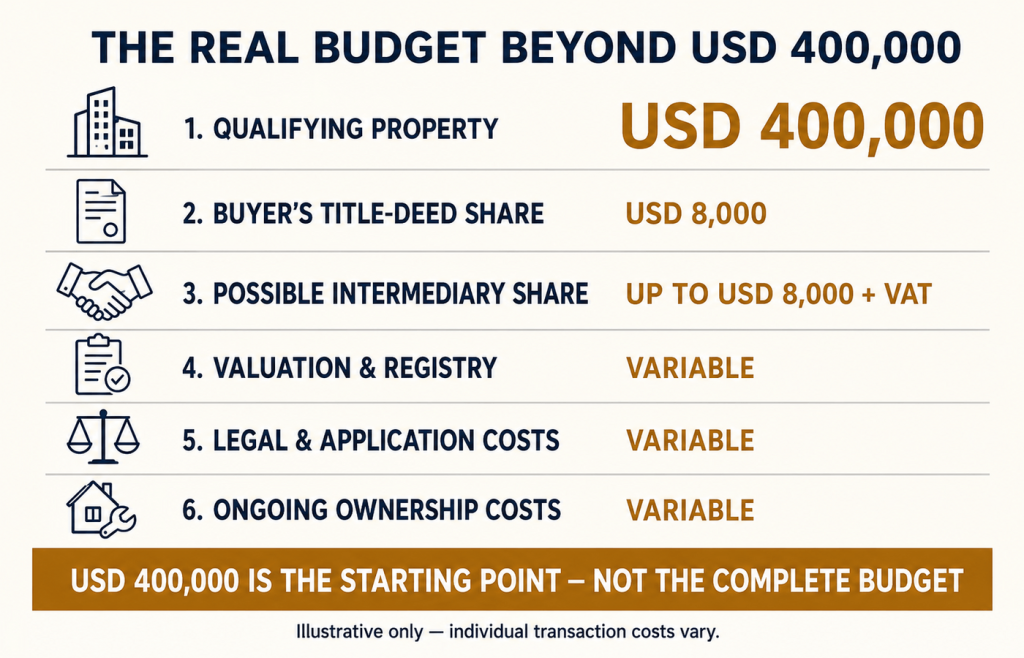
Turkish Citizenship by Investment Cost at a Glance
| Cost category | General 2026 position |
|---|---|
| Minimum qualifying property value | USD 400,000 or permitted foreign-currency equivalent |
| Mandatory property holding period | At least three years |
| Buyer’s statutory title-deed fee | Generally 2% of the relevant transaction value |
| Total buyer-and-seller title-deed fees | Generally 4%, subject to the parties’ contractual allocation |
| Property valuation | Required; cost varies by property and applicable tariff |
| Land Registry revolving-fund charge | Variable and periodically adjusted |
| Compulsory earthquake insurance | Required for qualifying buildings; premium varies |
| Property agency fee | Contractual; subject to Turkish regulatory limits |
| Legal and professional fees | Variable according to scope and complexity |
| Translation, notarisation and legalisation | Variable according to documents and family size |
| Residence and citizenship procedures | Additional government and administrative expenses may apply |
| Passport and identity-card expenses | Payable following approval |
| Ongoing ownership expenses | Property tax, insurance, maintenance and management where applicable |
The Republic of Türkiye Investment Office confirms that an eligible foreign investor may apply through the acquisition of property worth at least USD 400,000, provided a restriction preventing its sale for at least three years is registered against the title. Meeting the investment condition creates a basis for applying; citizenship remains subject to the prescribed assessment and government decision. Official Turkish investment and citizenship criteria
Is USD 400,000 the Total Cost of Turkish Citizenship?
No. USD 400,000 is the minimum qualifying value of the property investment. It does not include the full cost of purchasing, registering, reviewing and maintaining the asset or preparing the related immigration file.
The distinction is important:
The qualifying investment is not the same as the applicant’s total transaction budget.
An investor may purchase a property advertised at USD 400,000 and still encounter a problem if the amount accepted in the official valuation, title-deed records, banking evidence or foreign-exchange documentation falls below the required threshold.
The General Directorate of Land Registry and Cadastre indicates that the values used in determining citizenship eligibility—including the valuation, declared transaction price, foreign-exchange purchase documentation and payment records—must each support the required investment amount. Official Land Registry guidance for foreign buyers
For this reason, an investor should not transfer funds or pay a non-refundable reservation deposit solely because a sales brochure describes a property as “citizenship eligible”.
1. The Qualifying Property Investment
The largest component of the budget is the property itself.
To use the property route in 2026, the investor must acquire qualifying real estate with an accepted value of at least USD 400,000 or the permitted foreign-currency equivalent.
Depending on the applicable rules and the structure of the transaction, an investor may potentially purchase:
- A residential apartment
- A villa or house
- Eligible commercial property
- An eligible resale property
- A completed unit from a developer
- More than one qualifying property
- Certain land or development interests, subject to additional restrictions
Not every property available to a foreign buyer will be suitable for a citizenship application. The asset, seller, previous ownership, official valuation, payment method and title-deed registration must all be checked.
For detailed guidance on valuation, title-deed checks, payments and eligible property types, read our Turkish Citizenship Through Real Estate Guide.
Why a valuation buffer may be prudent
There is no statutory “buffer amount” that every investor must add to USD 400,000. Nevertheless, purchasing at exactly the minimum threshold can create a valuation risk.
For example, assume that:
- The negotiated purchase price is USD 400,000
- The investor transfers USD 400,000
- The recognised valuation is equivalent to USD 390,000
The investor may have paid the seller USD 400,000, but the property may still fail to satisfy the citizenship value requirement.
A sensible buffer must be determined from the property’s independent market assessment. It should not be selected arbitrarily or based only on a developer’s assurance.
2. Title-Deed Transfer Charges
Property transfers in Türkiye are subject to title-deed fees.
The General Directorate of Land Registry and Cadastre states that the buyer and seller are each charged 20 per thousand—equivalent to 2%—on the declared transaction value, provided that value is not below the relevant property-tax value. This creates a combined statutory charge of 4%. A separate revolving-fund service charge is also collected. Official Land Registry fee guidance
On a USD 400,000 transaction, the basic calculation would be:
| Party | Indicative calculation |
|---|---|
| Buyer’s 2% share | USD 8,000 equivalent |
| Seller’s 2% share | USD 8,000 equivalent |
| Combined 4% charge | USD 16,000 equivalent |
This does not necessarily mean every purchaser will pay the entire USD 16,000.
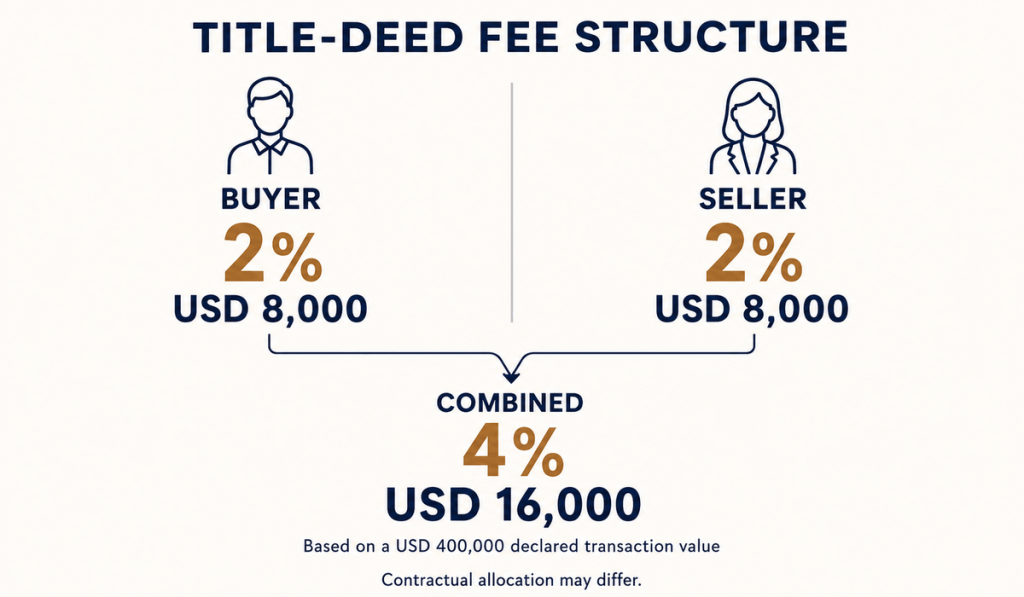
Under the statutory structure, the buyer and seller have separate shares. However, the sale agreement may allocate costs differently. Some contracts require the purchaser to bear part or all of the seller’s transactional expenses.
Before signing, the investor should establish in writing:
- Who will pay the buyer’s title-deed fee
- Who will pay the seller’s title-deed fee
- Whether any tax is included in the advertised price
- Whether the developer or seller expects reimbursement of its charges
- The value that will be declared in the title-deed documentation
An advertised “net price” and an “all-inclusive price” can produce very different final budgets.
3. Property Valuation Expense
A recognised valuation report is required for foreign property transactions and plays a central role in the citizenship assessment.
The report should not be treated as a formality. It assists the authorities in determining whether the property supports the required investment value and helps the investor identify potential overpricing.
The valuation expense is separate from the USD 400,000 investment. Its amount may depend on:
- The property type
- The number of units
- The property’s location
- Whether more than one title is involved
- The applicable valuation and Land Registry tariff
- Whether a revised or additional assessment becomes necessary
Where several properties are combined, separate reports or additional valuation work may increase the total expense.
The investor should also understand that paying for a valuation does not guarantee that the report will confirm the seller’s asking price.
4. Land Registry Revolving-Fund Charge
In addition to the percentage-based title-deed fee, the Land Registry collects a revolving-fund service charge.
This is a separate administrative expense. The applicable amount can change as official tariffs are revised and may be affected by the nature or location of the transaction.
It should therefore appear as a separate item in the transaction statement rather than being described vaguely as part of “government fees”.
5. Compulsory Earthquake Insurance
Compulsory earthquake insurance—commonly known as DASK—is generally required for buildings involved in title-deed transactions.
The premium is not a fixed amount for every property. It is calculated using factors such as:
- Property location
- Earthquake-risk classification
- Gross floor area
- Building type
- Construction characteristics
- Applicable annual tariff
Türkiye’s Natural Disaster Insurance Institution explains that the policy covers specified building damage caused directly by earthquakes and earthquake-related fire, explosion, landslide and tsunami risks. Official DASK guidance
DASK is not a substitute for comprehensive property insurance. Investors may separately consider broader cover for contents, water damage, liability, loss of rent and other risks.
6. Banking, Currency Conversion and Transfer Costs
A citizenship-related property purchase must be supported by traceable banking records.
For a foreign individual purchasing Turkish property, the transaction may involve:
- An international transfer fee
- Correspondent or intermediary-bank charges
- Receiving-bank charges
- Currency-conversion costs
- Exchange-rate margins
- Account-opening or compliance procedures
- Additional source-of-funds documentation
- A foreign-exchange purchase document, known as a Döviz Alım Belgesi
For citizenship applications, the authorities also require evidence connecting the purchaser’s payment to the seller and the relevant property.
The Land Registry’s current guidance states that the amount in the foreign-exchange purchase document is reflected in the official deed and that citizenship transactions additionally require evidence of the bank transfer from the purchaser to the seller. Official foreign-exchange documentation guidance
Why payment descriptions matter
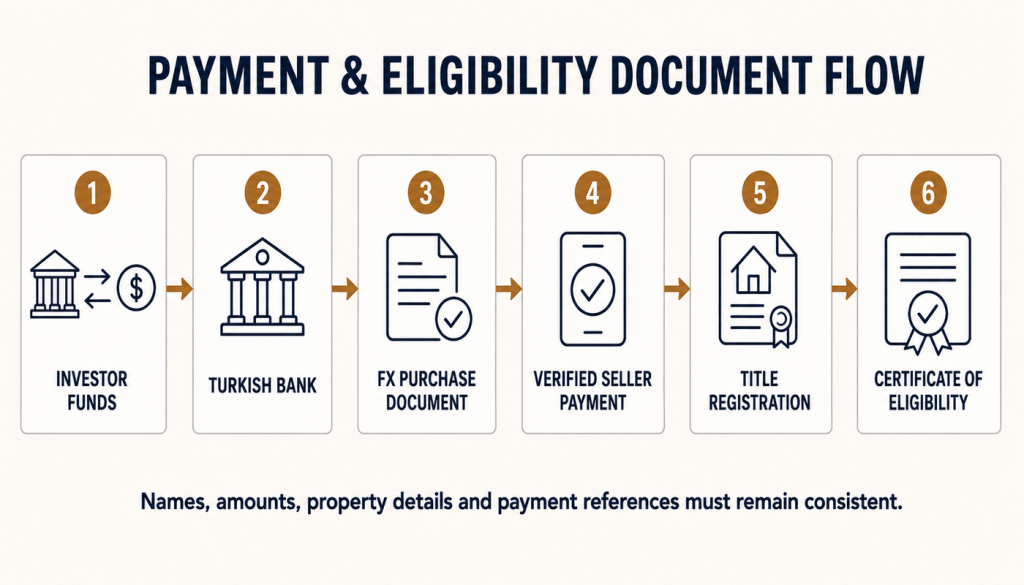
The names, property details and payment references should remain consistent across:
- The purchase agreement
- The valuation report
- The foreign-exchange purchase document
- The buyer’s transfer records
- The seller’s receipt
- The title-deed documentation
A transfer sent to an unrelated third party, a payment made without a property reference or a deduction that causes the recognised amount to fall below USD 400,000 may generate additional questions.
Investors should not transfer exactly USD 400,000 without confirming how bank charges and conversion deductions will be treated.
7. Legal Due Diligence and Professional Fees
Legal and professional fees are not included within the minimum investment.
The appropriate scope of due diligence depends on the property. A completed resale apartment may require a different review from an off-plan development, commercial unit or portfolio of several properties.
A structured property review may include:
- Confirming the registered owner
- Examining mortgages, attachments and title restrictions
- Reviewing the seller’s authority to complete the transaction
- Checking the property’s previous ownership
- Examining whether it has previously been used in a citizenship application
- Reviewing planning and construction documents
- Checking occupancy or habitation documentation
- Reviewing the reservation and sale agreements
- Assessing refund provisions
- Comparing the asking price with available market evidence
- Coordinating the three-year title restriction
- Checking the citizenship eligibility of the proposed transaction
Professional fees vary according to complexity and should be agreed in writing.
The engagement letter should state:
- The services included
- The services excluded
- Which third-party professionals will be involved
- Whether government charges are included
- Whether translation and notarisation are included
- Whether fees are refundable if the transaction does not proceed
The lawyer or adviser reviewing the transaction should be sufficiently independent to identify problems even where that advice may prevent the sale from completing.
8. Property Agency or Intermediary Commission
A property intermediary may charge a commission for introducing and coordinating the purchase.
Turkish rules provide that the aggregate service fee for an intermediated property sale should not exceed 4% of the contractual sale value, excluding VAT. Unless agreed otherwise in writing, that amount is divided equally between the parties. Republic of Türkiye Ministry of Trade guidance
On a USD 400,000 transaction, a default equal division of the maximum aggregate commission would represent:
- Up to USD 8,000 equivalent for the purchaser, excluding VAT
- Up to USD 8,000 equivalent for the seller, excluding VAT
The actual fee may be lower or included within another commercial arrangement.
The investor should ask:
- Is a commission payable?
- Who is legally entitled to receive it?
- Is VAT additional?
- Is the fee based on the advertised price or final contract value?
- Is it shared with another intermediary?
- When does it become payable?
- Is any part refundable if the property fails citizenship checks?
The agency commission does not form part of the USD 400,000 qualifying property value.
9. Translation, Notarisation, Apostille and Power of Attorney
Foreign documents frequently require translation, notarisation, apostille or consular legalisation before they can be used in Türkiye.
Possible expenses include:
- Passport translations
- Birth certificates
- Marriage certificates
- Divorce or custody documents
- Criminal-record certificates
- Name-change evidence
- Financial and corporate records
- Sworn translations
- Notarial certification
- Apostille charges
- Consular legalisation
- Courier expenses
- Power-of-attorney preparation
Where an overseas power of attorney is used, it must contain the appropriate authority and comply with the relevant form, certification and translation requirements. The official Investment Office provides detailed requirements for powers of attorney issued abroad. Official power-of-attorney guidance
Family size can materially affect this category. An application involving a spouse and several children will usually require more civil-status documents than a single-applicant file.
10. Residence-Permit and Citizenship-Application Expenses
The investment does not by itself complete the citizenship process.
The general procedure involves:
- Completing the qualifying investment
- Obtaining a Certificate of Eligibility
- Completing the prescribed investor residence-permit stage
- Submitting the citizenship application
- Undergoing government and security assessment
- Completing post-approval identity-card and passport procedures
Official guidance confirms that the investor category can also cover the foreign spouse and minor or dependent children where they apply with the principal investor. Official guide to foreign investors’ acquisition of Turkish citizenship
Potential expenses may include:
- Residence-permit charges
- Residence-card charges
- Citizenship-file preparation
- Biometric photographs
- Medical or insurance documentation where applicable
- Additional translations
- Courier and certification expenses
- Turkish identity-card charges after approval
- Passport-book and passport-related charges
These charges may change and can depend on nationality, document requirements and family composition. They should be quoted separately from professional advisory fees.
11. VAT and Developer-Related Charges
VAT may be relevant to certain property purchases, particularly first sales or developer transactions.
Its treatment depends on the property, seller, transaction structure and any exemption for which the purchaser may legally qualify. An investor should not assume that:
- VAT is always included in the advertised price
- Every foreign purchaser automatically receives an exemption
- VAT can be counted towards the USD 400,000 citizenship threshold
- Furniture and service packages increase the qualifying property value
The contract should clearly identify:
- The net property price
- Any VAT payable
- Whether an exemption is being claimed
- The evidence required for that exemption
- What happens if the exemption is refused
- Whether furniture, parking, storage or other items are separately priced
The current Land Registry implementation guide distinguishes the property sale price from VAT, commission, taxes, fees and expenses when assessing the foreign-exchange and qualifying transaction documentation. Such additional costs should not be relied upon to satisfy the investment threshold. Official Land Registry implementation guidance
12. Furnishing, Maintenance and Property Management
The investor’s financial responsibility continues after the title transfer.
Depending on the property, additional costs may include:
- Furniture and appliances
- Utility connection deposits
- Building or community service charges
- Property-management fees
- Tenant-finding fees
- Repairs and maintenance
- Comprehensive insurance
- Vacancy periods
- Cleaning and inspection
- Accounting for rental income
These expenses do not count towards the citizenship investment.
A property offering an attractive gross rental figure may provide a substantially lower net return after management, maintenance, tax, vacancy and currency movements are considered.
A Practical USD 400,000 Budget Illustration
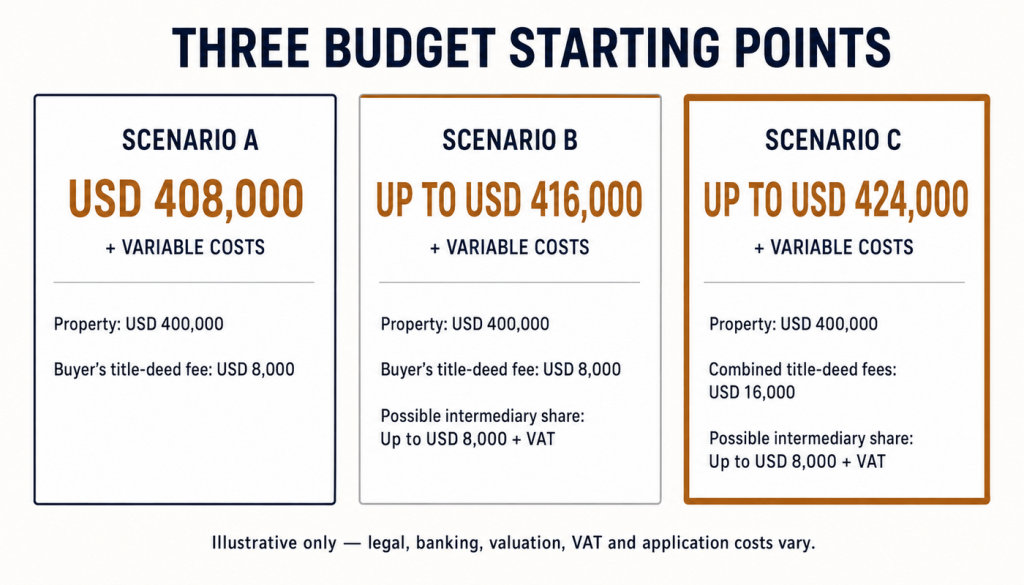
The following examples are for planning only. They are not quotations and exclude variable legal, government, banking, insurance and document expenses.
Scenario A: Purchaser pays only their statutory title-deed share
| Item | Illustration |
|---|---|
| Qualifying property | USD 400,000 |
| Buyer’s 2% title-deed fee | USD 8,000 |
| Subtotal before other expenses | USD 408,000 |
| Valuation, DASK and revolving-fund charges | Additional |
| Legal and professional support | Additional |
| Banking and foreign-exchange expenses | Additional |
| Translation and application expenses | Additional |
| Agency commission, if applicable | Additional |
Scenario B: Purchaser pays their title-deed share and an intermediary fee
| Item | Illustration |
|---|---|
| Qualifying property | USD 400,000 |
| Buyer’s 2% title-deed fee | USD 8,000 |
| Illustrative buyer intermediary share up to 2% | Up to USD 8,000, excluding VAT |
| Subtotal before other expenses | Up to USD 416,000 |
| Other transaction and application expenses | Additional |
Scenario C: Contract requires purchaser to bear both title-deed shares
| Item | Illustration |
|---|---|
| Qualifying property | USD 400,000 |
| Combined 4% title-deed fees | USD 16,000 |
| Illustrative buyer intermediary share up to 2% | Up to USD 8,000, excluding VAT |
| Subtotal before other expenses | Up to USD 424,000 |
| Other transaction and application expenses | Additional |
These examples demonstrate why USD 400,000 should never be presented as the complete Turkish citizenship by investment cost.
A responsible budget should also include a contingency for valuation, banking, documentation and ownership expenses. The appropriate contingency can only be determined after reviewing the property, contract and applicant’s family circumstances.
Costs That Do Not Count Towards the USD 400,000 Requirement
Investors should not assume that the following expenses increase the qualifying property value:
- Title-deed fees
- VAT
- Property agency commission
- Legal fees
- Advisory fees
- Valuation expenses
- Notary and translation charges
- DASK premiums
- Bank-transfer fees
- Furniture and appliances
- Property-management charges
- Citizenship and residence-permit expenses
- Passport and identity-card charges
- Maintenance and service charges
The USD 400,000 requirement must be supported by the recognised property and transaction values, not by the investor’s total expenditure.
Ongoing Costs During the Three-Year Holding Period
A qualifying property cannot be sold during the registered three-year restriction. During that period, the owner may remain responsible for:
- Municipal property tax
- DASK renewal
- Additional property insurance
- Building service charges
- Repairs and maintenance
- Property management
- Rental-income reporting and tax, where applicable
- Accounting or tax-advisory expenses
- Utility and vacancy costs
- Currency-conversion costs when transferring income abroad
Citizenship, immigration residence and tax residence are separate legal concepts. Obtaining Turkish citizenship does not remove tax obligations arising from Turkish property or Turkish-source rental income.
Selling After Three Years: Citizenship and Tax Rules Are Different
The three-year restriction is a condition of the citizenship investment. It should not be confused with the Turkish tax treatment of a later sale.
An investor may generally consider selling after the three-year restriction has been completed and formally removed. However, a sale after three years may still occur within the separate five-year period relevant to the taxation of certain property gains.
The Turkish Revenue Administration’s 2026 guidance explains the calculation and declaration of gains where property is disposed of within five years of acquisition. Official 2026 property-disposal tax guide
Exit planning should therefore consider:
- Confirmation that the citizenship restriction has ended
- Removal of the restriction from the title
- Seller-side title-deed costs
- Agency commission
- Potential capital-gains tax
- Currency movements
- Outstanding property tax or service charges
- The property’s actual resale liquidity
Common Budgeting Mistakes
Treating USD 400,000 as an all-inclusive package
The statutory threshold applies to the qualifying investment, not every transaction and application expense.
Relying on the advertised price instead of the valuation
The seller’s price does not control the official valuation.
Paying a deposit before eligibility checks
A reservation agreement may give the seller a right to retain the deposit even if the property later fails citizenship checks.
Allowing bank charges to reduce the recognised payment
The payment evidence should support at least the required qualifying value.
Assuming the seller will pay their own fees
The contract may transfer seller-side expenses to the purchaser.
Counting furniture or VAT towards the threshold
Additional commercial charges should not be relied upon as part of the qualifying property value.
Ignoring annual ownership costs
A three-year holding period creates continuing responsibilities even if the investor does not live in Türkiye.
Focusing on citizenship eligibility but ignoring investment quality
A property may technically qualify for citizenship yet still be overpriced, difficult to rent or challenging to resell.
Budget-Control Checklist Before Committing
Before paying a reservation fee or signing a binding agreement, the investor should obtain written confirmation of:
- The property’s agreed purchase price
- The preliminary market assessment
- The expected recognised valuation
- The amount shown in the foreign-exchange documentation
- The amount to be declared at the Land Registry
- The required payment route
- The buyer’s title-deed charges
- Any seller charges allocated to the buyer
- VAT treatment
- Agency commission
- Legal and professional fees
- Valuation and Land Registry expenses
- Translation and notarisation requirements
- The deposit refund terms
- Estimated annual ownership expenses
- The process for registering the three-year restriction
The transaction should satisfy two separate tests:
- It must comply with the Turkish citizenship rules.
- It should represent a commercially reasonable investment for the purchaser.
Passing one test does not automatically satisfy the other.
Frequently Asked Questions
How much does Turkish citizenship by investment cost in 2026?
The minimum qualifying property value is USD 400,000. The total budget is higher once title-deed fees, valuation, insurance, professional services, banking, translations and application expenses are included.
Is USD 400,000 enough for the entire process?
No. It is the minimum property value, not an all-inclusive application cost.
How much is the buyer’s title-deed fee?
The buyer’s statutory share is generally 2% of the relevant transaction value. The contract should be checked because the purchaser may also agree to bear other charges.
Does the property agency fee count towards USD 400,000?
No. Commission is a separate service expense and should not be relied upon as qualifying property value.
Can VAT count towards the investment threshold?
VAT and similar expenses should not be assumed to form part of the qualifying property value. The property price and tax treatment should be separated clearly in the contract and payment documentation.
Do family members require another USD 400,000 investment?
A spouse and qualifying minor or dependent children may generally apply with the principal investor without a separate USD 400,000 property purchase for each person. Additional documentation and application expenses may still arise.
Is the official valuation always the same as the purchase price?
No. The valuation may be lower or higher than the negotiated price. The application must satisfy the applicable recognised-value requirements.
Can citizenship be guaranteed after purchasing property?
No. A compliant property investment establishes a basis for applying. Final approval remains subject to documentation, due diligence, national-security and public-order assessment, and government decision.
How Red Ray Capital Can Assist
Red Ray Capital helps investors coordinate the financial, property and application components of Turkish citizenship by investment.
Our support may include:
- Preliminary investor and family assessment
- Comparison of property and other investment routes
- Property sourcing and initial market review
- Coordination of independent property due diligence
- Developer and seller checks
- Review of transaction costs
- Valuation coordination
- Banking and payment planning
- Source-of-funds preparation
- Title-deed transfer coordination
- Registration of the three-year restriction
- Certificate of Eligibility support
- Residence-permit coordination
- Citizenship-file preparation
- Family-document review
- Post-purchase property support
- Planning for the end of the holding period
Where Turkish legal, tax, valuation or regulated financial advice is required, Red Ray Capital coordinates with appropriately qualified professionals.
Start With a Complete Cost Assessment
The correct question is not simply, “Can I purchase a property for USD 400,000?”
The more useful questions are:
- Will the property satisfy every applicable citizenship-value test?
- What is the complete acquisition and application budget?
- Which expenses will be paid by the purchaser?
- Is the property commercially sensible without relying on citizenship?
- Can the source and movement of funds be documented properly?
- What will it cost to own and eventually sell the property?
A complete assessment should be undertaken before a substantial payment is made.
Disclaimer: This article is provided for general information only. It does not constitute legal, tax, financial, immigration or investment advice. Investment thresholds, government fees, tax rules and administrative procedures may change. Eligibility and final citizenship approval are subject to the relevant Turkish authorities. Applicants should obtain current advice from appropriately qualified professionals before entering into a transaction or transferring funds.